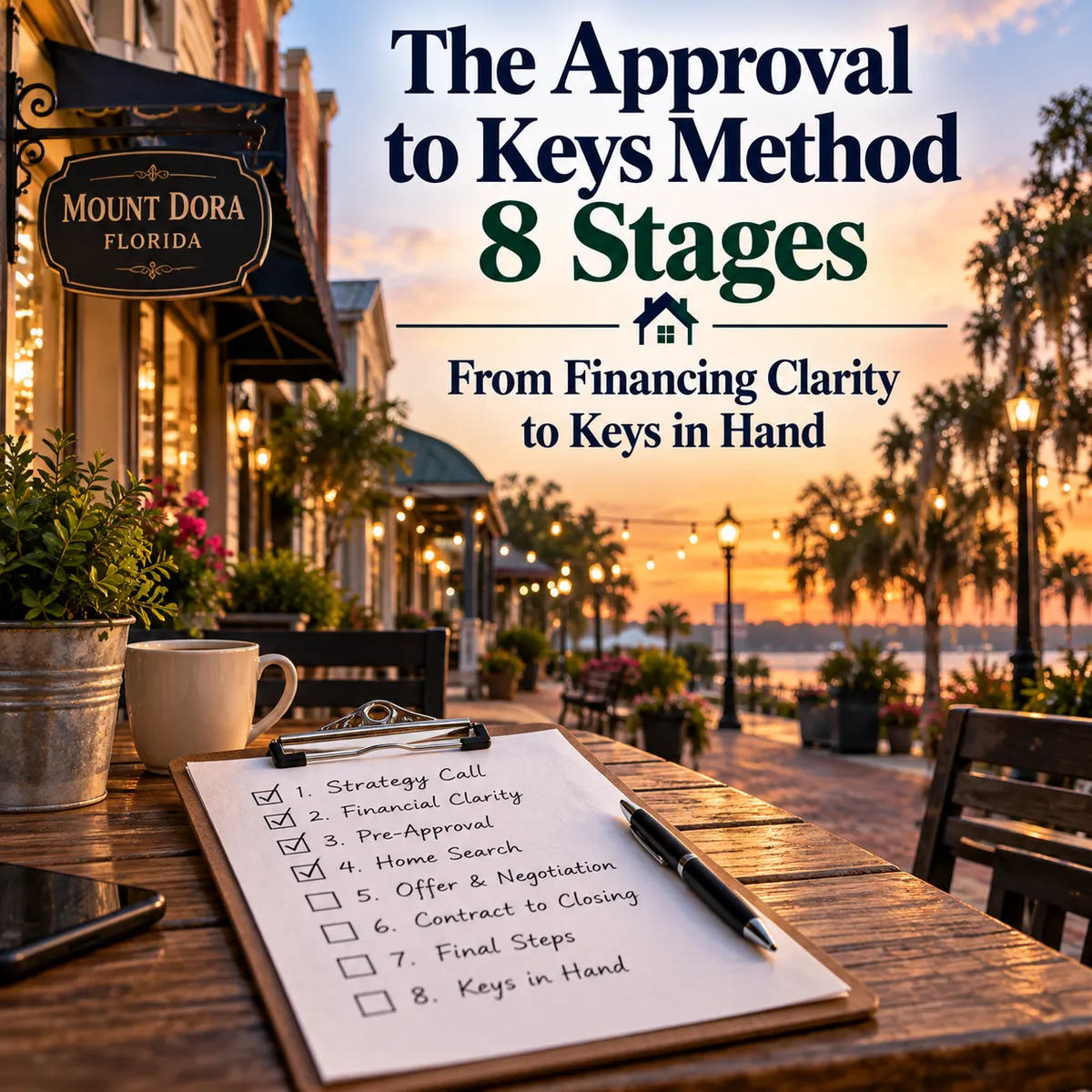
The Approval to Keys Method: What Actually Happens at Each Stage
Darrell Teddick is a REALTOR® in Lake County, Florida who built the Approval to Keys Method, an eight-stage process for buying a home, so buyers always know what happens next instead of guessing.
Short answer: it's a fixed order, financing clarity first, then market reality, then the search, then the offer, then the close. Every buyer goes through the same eight stages, in the same order, because skipping ahead is where most buyer mistakes actually happen.
Why a Fixed Order Matters
Most of the stress buyers feel isn't about any single decision, it's about not knowing what decision comes next. A buyer who starts touring homes before they know their real budget is making decisions in the wrong order, and they usually don't find out until they're attached to a house they can't get financed.
The Approval to Keys Method exists because financing and the sale aren't two separate problems handled by two separate people. Darrell runs the real estate side, his wife Tracy Freeman runs financing as a licensed loan officer at Mpire Financial (NMLS# 2174804), and the order below is how the two halves stay in sync instead of drifting apart.
Stage 1: Buyer Readiness Review
Before anything else, a direct conversation about where the buyer actually stands financially right now. Not a five-minute online pre-qualification form, a real conversation about income, debt, savings, timeline, and what "ready" actually means for that specific buyer.
Why it's first: every stage after this one depends on a real number. Skip this and every later stage is built on a guess.
Stage 2: Approval Clarity Session
Tracy runs the buyer's actual numbers and explains, in plain language, what they qualify for and why. Not just a number, the reasoning behind it, so the buyer understands their own financial picture instead of just being handed a figure.
Why it's second: a buyer who understands their number stops second-guessing it later. A buyer who was just handed a number without explanation starts doubting it the first time a seller pushes back.
Stage 3: Market Reality Reset
A straight look at what that real number actually buys in Lake County and Mount Dora right now. No sugarcoating, no "stretch a little and you'll find something." What the number buys is what the number buys.
Why it's third: this is where the budget from Stage 2 meets the actual market, so expectations get set correctly before the buyer falls in love with anything.
Stage 4: Search Criteria Calibration
Narrowing the search to what actually fits the real budget and the buyer's real must-haves, not a scattered list of saved searches built on hope.
If a buyer feels like they already know what they want here: that's fine, this stage still runs, it just moves faster. It's not extra steps for the sake of process, it's making sure the criteria match Stage 3's reality before house-hunting starts for real.
Stage 5: Guided Home Tour Strategy
For buyers who can be at every showing in person, this stage is straightforward scheduling. For buyers who can't, out-of-state relocation buyers especially, this is where video walkthroughs, virtual tours, and in-person visits get sequenced so no offer gets made blind.
If a buyer doesn't need this because they're already local and available: the stage still exists, it's just simpler. The point isn't extra steps, it's that nobody skips straight from "criteria" to "offer" without an actual plan for seeing homes.
Stage 6: Offer Positioning Plan
Structuring the actual offer with financing already lined up and verified, so a seller is looking at a buyer who's ready to close, not a buyer who might fall through.
Why it's sixth: an offer built without verified financing behind it is a weaker offer, period, regardless of price. This stage is what makes the offer real instead of hopeful.
Stage 7: Contract-to-Close Oversight
Once an offer is accepted, one team, Darrell and Tracy, watches every deadline: inspection window, appraisal, financing contingency, insurance, title. Not two offices each watching their own half and hoping the other one catches what they miss.
Why it's seventh: this is the stage with the most moving parts and the most ways for a deadline to quietly slip. One team watching all of it is the entire point of the integrated structure.
Stage 8: Keys in Hand Completion
Closing day, handled by the same two people who've had the file since Stage 1. No new faces at the closing table, no "let me check with the other office."
How Long This Actually Takes
There's no fixed timeline for the whole method, because Stage 1 through Stage 4 move at the buyer's own pace and Stage 5 through Stage 8 move at the market's pace. What's fixed is the order, not the calendar. A buyer who's already financially organized can move through the early stages quickly. A buyer who needs more time to get their financial picture clear takes that time, because Stage 2 is not a stage worth rushing.
Frequently Asked Questions
Do I have to go through every stage even if I think I don't need one?
Every stage runs, but not every stage takes the same amount of time. A buyer with straightforward finances moves through Stage 1 and 2 quickly. A buyer already living locally moves through Stage 5 quickly. The order stays fixed because that's what prevents the actual mistakes; how long each stage takes flexes to the buyer.
Can I start at Stage 3 if I already know my budget from another lender?
Stage 1 and 2 still happen, because "another lender told me a number" and "Tracy verified the number against my actual financials" aren't the same thing. It moves fast if the buyer's paperwork is already in order.
What if I'm not ready to buy yet, just researching?
Stage 1 is a fine place to start even for buyers who are 6-12 months out. Knowing the real number early removes guesswork from the whole research phase.
The Next Step
Every buyer starts at Stage 1, the Buyer Readiness Review, regardless of where they are in their search already. Call Darrell Teddick at (352) 720-2775 or visit approvaltokeys.com to start there.
Related reading: How Financing Actually Works for Out-of-State Buyers, What Out-of-State Buyers Get Wrong About Central Florida Pricing, Meet Darrell and Tracy
